
As someone who started their blacksmithing business in 2022, I’m not exactly an expert on the subject. However, I can tell you I’ve learned a lot and I wanted to share that with you. Sometimes I think the best articles on subjects like this are by those currently going through it while it’s still fresh in your mind.
Ground Level – Getting Your Blacksmithing Business Started
I’m going to assume you have your tools and know how to blacksmith. I’m not saying you need to be advanced or even intermediate. Heck. When I started I’d consider myself a seasoned beginner. And there’s my first point. Even a beginner can start a blacksmithing business.
However, if you’ve stumbled in here as a complete novice with the idea of starting a blacksmithing business, then check out my article on how to get started blacksmithing as well. Related, I also have an article on ways to improve as a beginner smith.
There are things we do as smiths that always impress the public and I would say the #1 thing that does that is twists. Yep. Putting a twist in metal is something every beginner learns. When I started my blacksmithing business I sold bottle openers, J hooks, and some very simple fire pokers. None of them were anything special but they all had a twist in them and people just love that. Seriously.
I did my first show in October 2022 (more on shows below). It was a weekend show (Saturday and Sunday) and I made $848 that weekend selling some very simple and basic stuff. I was blown away by the response to my items.
Here’s a few shots of the first show I ever did and some of the items I had. Nothing special.
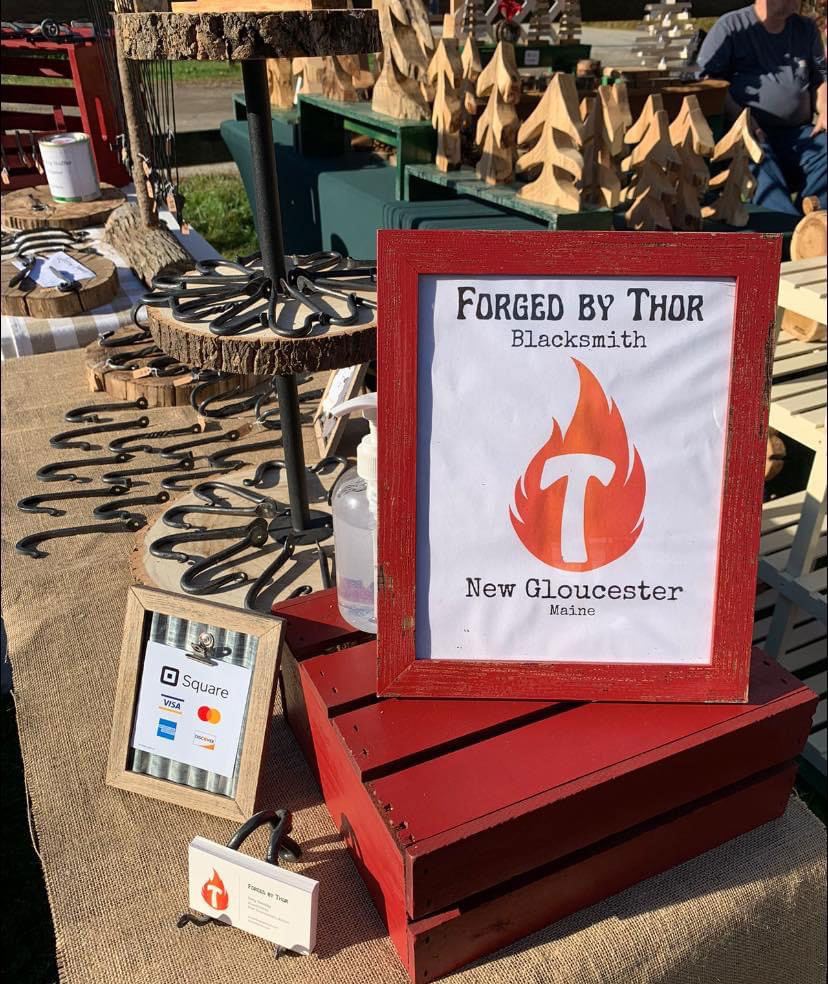
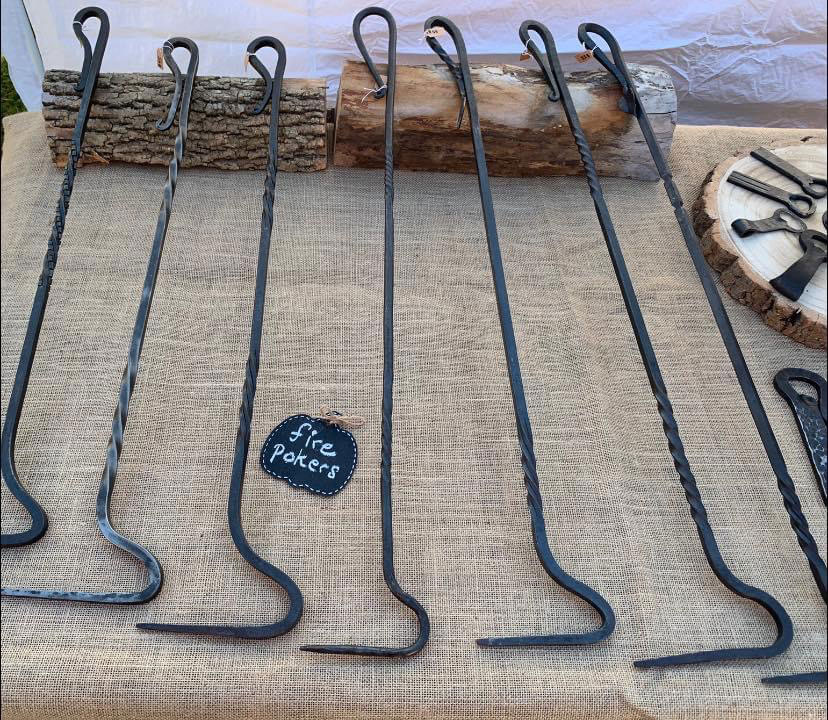
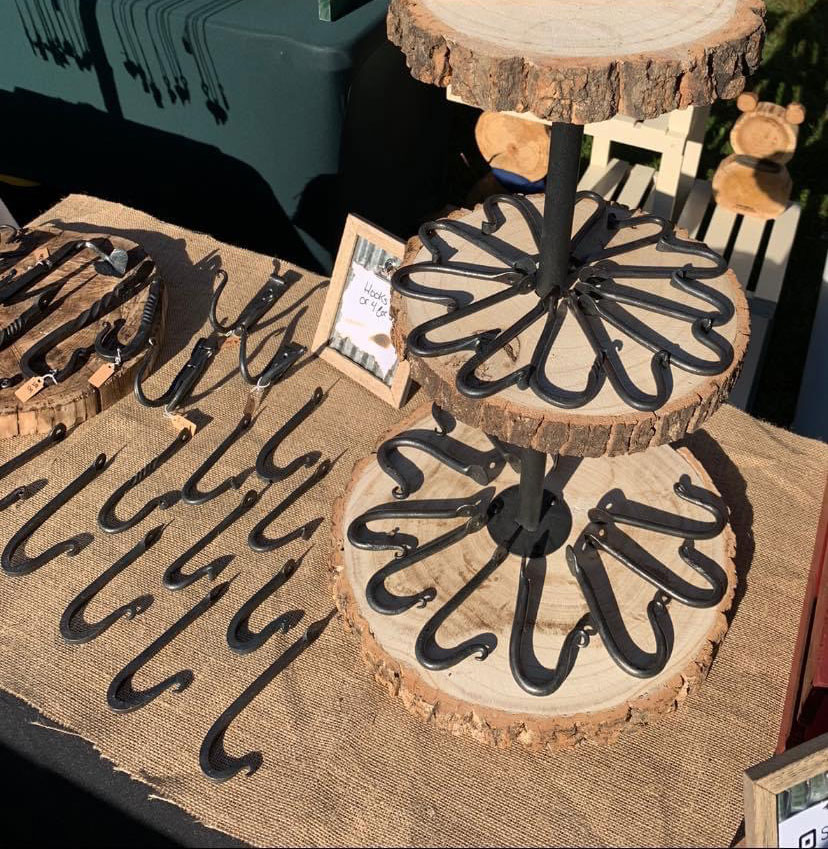
People are always impressed with blacksmiths. Taking hot metal and shaping it, twisting it, bending it, etc. The whole concept seems foreign to many people. So even very basic items get a lot of attention and will sell much better than you think they will. Don’t let you experience, or lack thereof, turn you away from starting your blacksmithing business.
Repetition, Repetition, Repetition
Now before you start selling your items anywhere you need to practice making them. Anything you decide to sell you need to be able to replicate over and over. Whether that’s a J hook, a leaf pendant, or a knife. Consistency is key.
Not only do you want your items consistent so you can fill orders but you need the muscle memory of making them. How fast you can make items will help you get orders out timely and help improve your profit margin.
It’s worth mentioning that making jigs is a huge timesaver and greatly helps with consistency. Being able to consistently bend a hook and doing it in a few seconds on a jig instead of over your horn and spending time adjusting it is going to help you keep prices down or increase your profit. Either is a win.
Making jigs does take time but it’s a worthwhile investment of your time.
Form an LLC
Let’s step back from the trade side of things and get into the business side for a moment.
Creating an LLC (Limited Liability Company) is a way to protect yourself from your blacksmithing business. Let’s say someone is suing you because of a product you made (whatever the reason is). As a sole-proprietor business that person can go after you personally which includes your assets. As an LLC you have a shield between the business and you. If you were an LLC and being sued, then that person can only go after your blacksmithing business and its assets, not your personal assets.
Forming an LLC is cheap and super easy. Every state is a bit different but in Maine the paperwork took me 5 minutes to fill out. I sent it in with a check (rates vary state to state) and a few weeks later I had Forged by Thor, LLC. It was fast, easy, and cheap to do and now I have protection in case something horrible happens.
Open a Bank Account
I’m going to assume if you’re looking to start a blacksmithing business that you’re looking to do it legit. Meaning you plan on paying sales tax, income tax, and all the fun that goes with having a business.
To that end having a bank account for your business is one of the simplest things you can do to make your life easier. It’s far easier to keep track of income and expenses when your business has its own account. It’s also a legitimacy thing. Using your personal accounts for business can lead to issues down the road.
Get Insurance
You can get event insurance for your business if you plan on selling at craft fairs and events. In fact some of them will require it.
This insurance will give you liability and cover you in the case of loss of product while selling at an event. The company I use is ACT Insurance. It’s a popular choice for crafters because it’s easy to get and affordable.
Determine Legalities in Your State
In my state of Maine I have to file sales tax for my business. The sales tax in Maine is 5.5%. Meaning, for every product I sell in the state of Maine I have to pay the state 5.5% of that for sales tax. It also means I charge my Maine customers that 5.5% so I’m not eating it.
In order to file sales tax in Maine I had to get a Retailer Certificate. I went to my state’s website, found the form, filled it in, and I was done in a few minutes. Now every quarter I file my sales tax with the state.
In Maine that’s all I had to do. In some states you may not need to do this. In other states you may need to do more than just that. I can’t say. I’m not a legal expert but do look into what’s required of you to legally run a business in your state.
Get Business Cards
You’re going to need business cards. Period. It’s a matter of professionalism. If I meet someone who is selling something and they don’t have a business card, then I assume they don’t take it seriously. I’m not alone in that thought.
Also, digital business cards can be great, but trust me – get old school business cards too. Not everyone is into technology and grandma just might buy $200 worth of stuff from you if you hand her a card because she doesn’t have a smartphone. I can’t tell you how many times this has happened to me.
The Money Side of Things
This is a fun one – how much to charge? The answer is easier than you may think.
Paying Yourself
At the time of typing this (subject to change down the road) I charge $90 an hour for my work. It’s also an easy number to use for this explanation.
The reason I charge $90 an hour is simple.
First, I want to pay myself $30 an hour for my work. As a business you’re paying yourself and nobody is cutting you a check, taking taxes, etc. It’s just you. I want to put $30 an hour into my pocket to pay myself.
Now, I also need to invest back into the blacksmithing business to buy tools, metal, equipment, replace consumables (propane, grinding discs, etc). Of course I also need to pay that sales tax and income tax as well.
I watched a video by Christ Centered Ironworks where he talks about the business and he has a rule he calls the Rule of 33. It’s worth a watch but the short of it is everything is in thirds or 33%. Meaning, whatever you charge you put 1/3 in your pocket, 1/3 to the business, and 1/3 for taxes. It’s simple and considering Roy is a smith who has managed to build a very successful business, I decided to use his approach.
The reason I charge $90 an hour is again because I want to make $30 an hour. That means I need $30 an hour for business expenses, and $30 an hour for taxes. Therefore, $30 x 3 = $90.
You need to figure out how much you want to make and then multiply that by 3 to get your hourly rate.
I will say that the 33% I set aside for taxes has been more than I need. With business expenses and deductions I haven’t found I’ve needed that 33% to cover it. On the plus side that money I don’t need gets saved for a rainy day. Whether it’s needing a little extra money one month or buying a tool that’s expensive. I could choose to pay myself a bit more with the extra money but I’d rather save it for when my business needs it.
Charging for Your Products
The next step is how much you charge for your products. This is another simple one.
I’m charging $90 an hour for my work. If an item takes me an hour, then the base price is $90. I then have to determine how much the metal costs and add that in. I also determine how much propane costs and factor that in. For the propane I know how many hours I can forge on a single tank. I know how much it costs me to fill that propane tank. I can then figure out how much my propane costs me per-hour or per-minute to run my forge and in turn determine that expense. That gets added to the product price.
The last step is I add 10% to that number. The 10% is to give me some wiggle room in my pricing. I can offer a 10% discount selling an item and it doesn’t hurt the bottom line. It also helps cover things like when I snap drill bits or need to replace something I don’t normally need to. It’s just an extra margin for the unexpected.
Take that item I forged in an hour and here’s the math:
90 (hourly rate) + 10 (metal cost) + 1.80 (propane cost) = 101.80
101.80 x 1.10 (10% markup) = 111.98 so I'll round that to $112
I know $90 an hour may seem high if you’re new to blacksmithing. Charging that much per-hour for your work is hard to swallow but listen to me. Pay yourself what you’re worth. Also, pay yourself what you know you will be worth.
By that I mean don’t start out your blacksmithing business charging $45 an hour with the intent on raising that rate as you get better. Start your business by paying yourself what you need in order to grow the business and pay yourself a livable wage. Starting off at a lower rate will only slow the growth of your business and hurt your pocket.
Now, if you don’t need $30 an hour to make a livable wage, then by all means charge less. That’s the number I need. Maybe you only need to make $20 an hour (so $60 per-hour for your business), and that’s completely fine. Just don’t shortchange yourself starting off. I did and I regret it. Once I started charging a proper rate my business grew so much faster.
I will also add that you can choose to pay yourself less and your business more in order to grow faster. Some people, not just smiths, will not pay themselves when getting the business off the ground. They take that $90 an hour and it all goes to the business for growth and taxes. This is a fast way to get things off the ground if you can afford to not be paid.
For me one of the reasons I started my blacksmithing business was because I needed the money so not paying myself was not an option. However, it’s a valid approach and one that works.
At the end of the day you can slice your hourly rate a number of ways. Maybe you pay yourself 20% of the hourly rate, pay the business 60%, and save 20% for taxes. It’s up to you how you do it. Just take the time to sit down and figure it out instead of charging some arbitrary perceived value for your products.
I see too many people, not just smiths, who charge way too little for their work. I’ll ask someone how long it took them to make something and they’ll say an hour. I then look at the $30 price and shake my head. You can’t live off that. That $30 doesn’t even cover their time, never mind supplies, materials, and taxes.
As artists we feel like we have to sell our work for what we feel someone else is willing to pay. You feel like nobody would pay $80 for that fire poker so you charge $45. The customer gets an amazing deal and you’ve shortchanged yourself.
The reality is not every customer is YOUR customer. Not everyone will pay $80 for a fire poker and that’s fine. If everyone was willing to spend money on your products, then odds are you’re pricing it too low and they know it. Some people will think your prices are too high. It’s fine. They’re not your customer. Other people will think you charge too little even if you’re paying yourself a good wage. Those are the best customers.
Where to Sell Your Items & What to Sell
The what to sell part is tricky. This is going to depend on your skill, where you live, the average income in your area, etc. I mention where you live in regards to in-person sales. Obviously where you live isn’t a factor for online sales.
Anyway, as a starting point, these are items that I sold starting out that did well in-person.
- J hooks – Easy beginner product with a low price point.
- Bottle openers – Another relatively simple product that is affordable.
- Nails – Yep. Hand-forged nails is a nostalgia trip for some folks.
- Fire Pokers – This one will depend on your region a bit. These have a higher price point than other items listed but generally sell well.
- Pendants – These can be very simple. I don’t forge complicated pendants to keep the price low and these outsell anything else I offer at shows.
That should at least get you started. Those items were the staples of my early days when selling in-person.
Online sales you can step it up. Don’t be afraid to forge something that you sell for $200+ online. It’s a much bigger market of buyers online with a wider range of incomes than you might have at a craft fair.
Something I can’t stress enough with regards to what you sell is this. Do not sell items you hate making.
I had a lot of these starting out; things I just dreaded having to forge and restock for the next show or an order to fill. It made blacksmithing a chore and something I didn’t look forward to. I love blacksmithing, so something that has a negative impact on how I feel about it is something that has to go so I can continue to enjoy forging.
I still remove items I offer for sale if they are things that I do not enjoy making. The more experience I get, and the more diverse my skills become, I find there’s things I no longer enjoy making that I once did. It’s normal to evolve as a smith and artist and your products will reflect that.
Shows & Events
Finding craft fairs and events in your area is generally pretty easy depending on where you live. Some of them will be free to vendor at and some will charge a fee for being there.
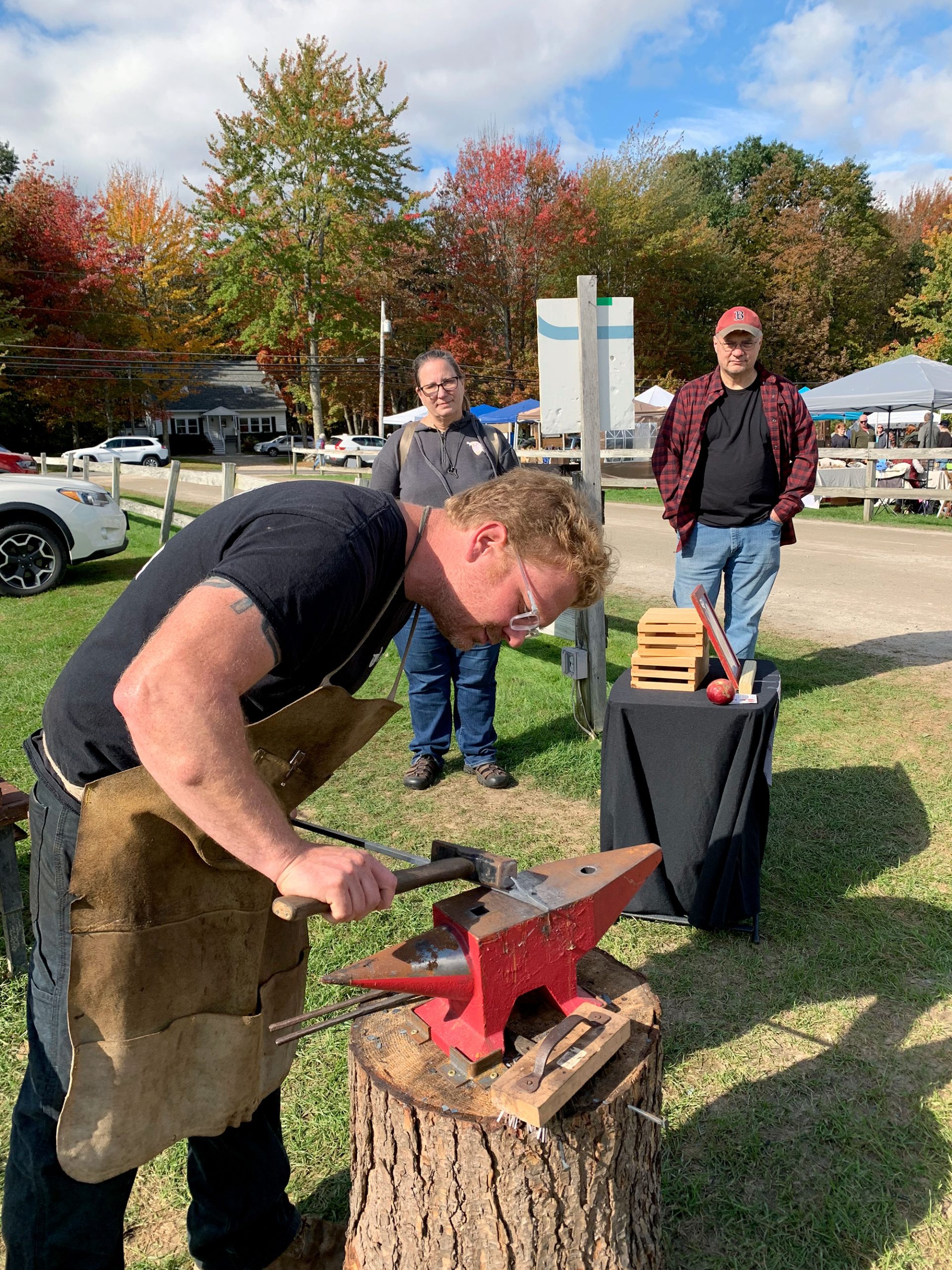
This is the quickest and “easiest” way to start making money for your blacksmithing business. I quoted easiest because while it’s easy to go to these events and sell, they are a lot of work. A lot. You have to create inventory to sell at the event. You want everything you sell in large quantities so you don’t run out of something. You have to get up early, arrive at the event early, setup your space, hang out for the 5-8 hours to sell your product, pack is all up after, and head home.
I will spend 1-2 weeks before and event just creating inventory. The day itself can be 10-12 hours long between travel, setup, the event itself, teardown, and driving home. It can be rough.
The great part is you will walk away with money in your pocket. I have had events that are 8 hours long and I will walk away with $2,500. I sell my items online too but I have never had a day of online sales even remotely close to $2,500. So these events are a great way to flush your business with cash to get it off its feet or to cover a bad month.
This is really the bread and butter approach to launching your blacksmithing business. Not just because of the quick cash but because it gets you in the community and meeting people. Word of mouth is still a very valid and legitimate way to grow your business. I live in a small country town and I swear everyone I meet knows who I am because of worth of mouth. It’s been amazing for my business.
Also, people love meeting the person who created the items they are interested in. I’m not much of a sales person (my wife is though), but I enjoy talking to people about how I make something, and blacksmithing in general, and they are interested in hearing it. All the while you’re out there, people are seeing your products, your handing our business cards, you’re making sales, and people are seeing your business.
Which Shows to Sell At
Lastly, and this one is important, when it comes to determining which shows and events to sell at take other people’s advice with a grain of salt. If someone tells you show A is an amazing show and they did well don’t assume you’ll do well.
Consider what they’re selling. Are they selling $5 craft items? Do they sell food or baked goods? These types of things cater to different people than hand-forged items do. Typically my items are at a higher price point than a lot of other vendors at shows. Not everyone comes to show expecting to drop $240 on a lamp I forged.
Sometimes you just have to do a show to find out if it works for you. However, things I consider for a show I’ve never done.
Where is it at?
I stick to “big” shows and not church fairs or hobbyist craft fairs. A big show could be one at an apple orchard during picking season at a popular apple farm where there’s other artisans. It could be an annual farm day at a large farm, or an art festival in the center of a busy college town, etc. More on this below.
What type of crowd do I expect it to draw?
Take an artisan fair for example. The crowd there expects to be paying top-dollar for handmade items; they know what they’re attending. A church fair by contrast is going to pull a smaller crowd that isn’t expecting to spend a lot of money. You don’t need a huge crowd to make money – you need the right crowd.
How close is the event and how much to attend as a seller?
I generally stick to shows an hour or less from my house. As noted above, a day of selling can be 10+ hours long between everything and that’s for something close. Add time to that for something further away.
If the cost to sell there is a lot I need to consider if I feel it’s worth the price. Will I sell enough to make back that cost and put enough in my pocket to make the day worthwhile? If I’m putting in a 10 hour day, had a to pay $120 to setup a table, and only made $400 in sales ($280 in profit), then that’s just not worth it to me.
Online Sales
Etsy
Everyone has heard of Etsy. The good, the bad, the ugly. Well, for better or worse it’s the best place to sell your products online.
Luckily in the blacksmithing area there’s not much competition on Etsy unlike other areas of crafting. There are not thousands of smiths on there selling stuff. Mostly it’s a handful of people.
How to go about selling your stuff on Etsy is another article entirely. There’s a lot of nuance in setting up and listing your items. Not that any of it is complicated. It’s just to get the most out of your listings there’s some things you should do. It’s called SEO (search engine optimization). Check out articles on Etsy SEO and you’ll be in good shape.
I will note that Etsy can, depending if you’re running ads or not, take around 15% of the item price for their cut. If you want to make $100 on an item, then sell it on Etsy for $115 to cover that 15% cut they take.
Website
You can build your own website as well to sell. Whether that’s using WordPress like I do or something like Shopify. The nice part with this is you keep more of your money. You’re still going to pay credit card processing fees or fees to PayPal/Venmo, etc. but it’s less than Etsy takes by a lot.
The downside is your own site is a lot of work. With Etsy you have a built-in customer base. People are all over Etsy searching for items and hopefully yours comes up. With your own site you have to bring in the traffic and then you have to sell them.
To give you an idea. Last year Etsy sold 60% more than my own site did. Of course it’s worth having my site and selling here even though Etsy sells more because without my site I wouldn’t have had the sales I did. I would have lost money by not having my own site.
Diversify
So no matter what you plan to do for online sales in the grand scheme of things, definitely work on getting yourself a site as well. Never put all your eggs in one basket. If you only sell on Etsy, and something happens forcing you to remove your blacksmithing business from there, then you’re dead in the water. If you have your site to fall back on at least you’re still in business.
There are some other sites out there like Etsy. A quick Google search will show you a few. I’ve researched a bunch and none of them have seemed worthwhile. You can also sell on Amazon but that’s something I’ve not heard good things about so I haven’t bothered.
Investing in Your Blacksmithing Business (and Yourself!)
I’ll wrap up this article on investing in your business.
One of my biggest pieces of advice on buying tools for your blacksmithing business is this. Buy what you don’t have first. Once you have everything you think you need, then invest in upgrading your tools.
Maybe you don’t have the best forge but it works and gets the job done. However, you don’t have a drill press – something I’d strongly recommend getting. Instead of getting a better forge buy a drill press. Get those things you do not own first. It’s better to have something that’s not perfect than not having it at all.
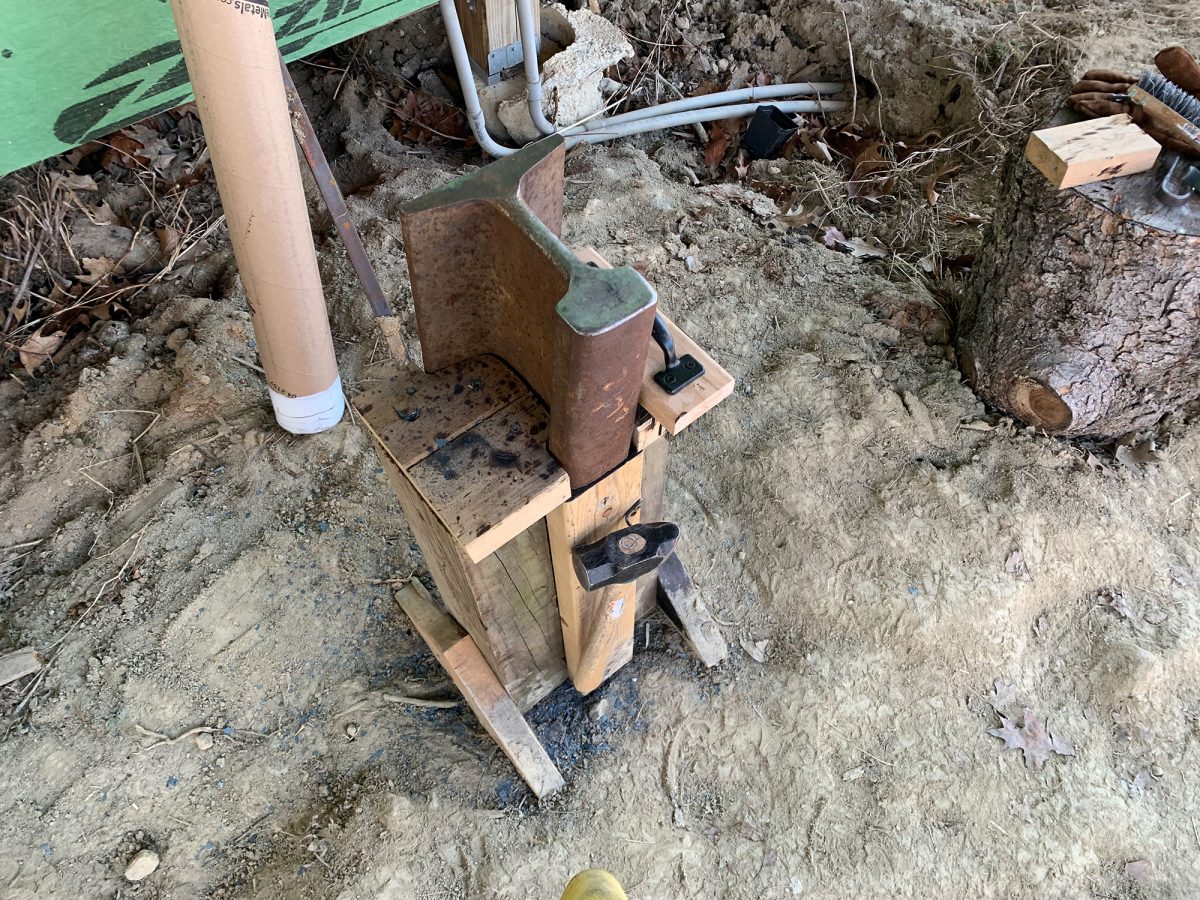
Here’s a picture of my first anvil. It was a railroad track. Instead of replacing that anvil I bought a drill press because I didn’t have one. The amount of time I saved by having that drill press was well worth it. Sure, railroad track isn’t the best anvil out there but it did the job for the time.
Then there’s investing in yourself. This part is hard and I struggle with this a lot. This is doing things like taking the time to learn, experiment, and to fail. This was easier when my blacksmithing business was new but now I’m pushing out orders constantly and finding the time to just play and figure things out is hard to come by.
I find the winter months are slow for my blacksmithing business so this is when I do that. I’ll work on new items, prototypes, try new techniques or learn how to improve on existing ones.
This includes taking classes if you can. I find learning new things in a class environment very rewarding and refreshing. I hated school growing up but as a smith I look forward to taking classes to learn new things. I find I can just focus on what I’m seeing and hearing. The spiraling thoughts about the orders I need to work on or the finances disappear. I always leave a class feeling inspired and ready to put those new skills to use.
I wrote an article on this subject as well if you’d like to hear more about how taking a class is an investment.
Conslusion
This is a living article where I’ll keep updating it. This is a rather daunting subject to tackle and I know I’ll have forgotten to cover something I wanted to. Likewise, if you have a question, then please leave a comment. I’d love to help as many of you as I can start your own blacksmithing business. I may not have all the answers but I’ll do my best and we can all learn together.
The point about not undercharging really lands, since a lot of new craftspeople price based on what they think customers will accept rather than what the hourly math actually requires. I liked that you separated the tax and reinvestment portion out clearly instead of just talking about profit as one lump number. Curious whether the ratio has shifted much for you as material costs went up recently.
You’re absolutely right about new people pricing on what they think people would reasonably pay. I did the same thing starting out and I wish I had this advice when I began.
My costs for materials have been not really been impacted. I’m working on a smaller scale for most of my work. A bottle opener might be 20 cents worth of material so even if it went to 30 cents it’s not impacting my bottom line. I imagine it’s much different for folks doing architectural work and other large forms.